Pros and Cons of Slab Foundations
What to Know Before Choosing a Slab Foundation for Your Home
When you’re building a new home, the foundation is one of the first and most important decisions you’ll make. It supports the entire structure, affects construction costs, and can influence comfort, maintenance, and long-term durability. One of the most common options today is a slab foundation, which involves pouring concrete directly on the ground to create a single, solid base for the house.Thinking about building your dream home, retirement or empty nester home, or starter home – if you’re just beginning life on your own, perhaps with a young family? One of the first decisions you’ll have to make is what kind of foundation you should build the house on.
Slab foundations are popular in many parts of the country because they are relatively quick to build and often cost less than other foundation types. However, they are not the best fit for every climate, site condition, or homeowner priority. Understanding how slab foundations work, along with their advantages and drawbacks, can help you decide whether this foundation type makes sense for your home and where you plan to build.
What Is a Slab Foundation?
A slab foundation is a type of house foundation made by pouring a large, thick slab of concrete directly onto prepared ground. This concrete slab is typically both the foundation and substructural base floor of the home. Unlike crawl space or basement foundations, slab foundations do not have space beneath the house.
Most slab foundations are four to six inches thick and reinforced with wire mesh or steel rebar for strength. They may include thickened edges or footings around the perimeter to add additional support to load-bearing walls. Plumbing and utility lines are usually installed before the concrete is poured. This means they are embedded within or beneath the slab.
You may hear the terms “monolithic slab,” “monoslab,” and “slab-on-grade” used interchangeably. All of them refer to the most popular type of slab foundation used for new construction. The term “monolithic” simply means single-poured. A monolithic slab, monoslab, and slab-on-grade are one solid, continuous pour with thickened edges for added support.
Understanding the Role of a Home’s Foundation
A home’s foundation is the primary load-bearing portion of the structure. It must safely support the weight of the house, protect it from moisture, and help control vapors coming up from the soil. In most regions, foundation footings are also designed to extend below the area’s frost line to prevent shifting and cracking of the foundation caused by freeze-thaw cycles.
In residential construction, there are three main types of foundations:
- Slab foundations
- Basement foundations
- Crawl space foundations
No matter which type you choose, the foundation of the home has three main responsibilities:
- Supporting the structure above
- Keeping groundwater from entering the home
- Acting as a barrier against soil moisture and vapor
The suitability of each foundation type depends on the site, climate, and construction method, which is where the pros and cons of slab foundations come into play.

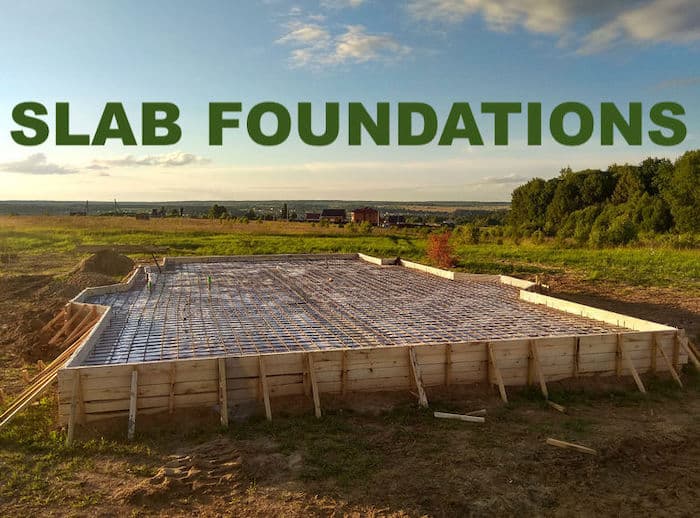
Here, a wooden formwork outline for a slab foundation is waiting for the concrete to be poured. Inside the form are a layer of gravel, a plastic vapor barrier, a layer of insulation, and a grid of steel rebar and thick wire mesh for reinforcement. The perimeter footing extends below the frost line (photo credit: © Andrii Tsynhariuk/123RF).
Pros & Cons of Slab Foundations
Advantages of Slab Foundations
Here are some of the reasons why choosing a slab foundation might be a good idea for you.
1. Lower Construction Cost
If you’re working within a budget, a slab foundation is often an attractive option because it typically costs less than other foundation types.
As of 2025, a monolithic slab foundation costs an average of $5 to $16 per square foot. By comparison, crawl space foundations range from $6 to $17 per square foot, while basement foundations can cost $20 to $37 per square foot. Depending on house design and site conditions, this difference can translate into meaningful savings on overall foundation costs.
In addition to lower home construction costs, a slab foundation can also help reduce your long-term energy expenses. Because there is no space between the ground and the home, you don’t have to pay to warm or cool “wasted space” – as long as the slab is insulated from the ground below.
2. Minimal Ongoing Maintenance
Slab foundations require little ongoing maintenance, resulting in long-term savings for homeowners.
As their design is relatively simple, less can go wrong over time. When constructed correctly (which they typically are), concrete slabs will last 50 years or more, and likely much longer, with minimal intervention. For homeowners, routine upkeep involves occasional visual inspections to ensure there are no cracks present or signs of movement, as opposed to the ongoing moisture, pests, or structural concerns associated with other foundation types.
3. Structural Strength and Stability
Slab foundations are known for their strength and stability, in part because they avoid some of the common weak points found in other foundation systems.
With a slab foundation, the concrete is typically poured as a single, continuous element. This reduces the risk of issues such as cold joints, which occur when there is too much time between concrete pours, and seams, where separate foundation sections meet. Both conditions can create potential points of weakness in a structure.
Because a slab foundation functions as one solid unit, it tends to be rigid, stable, and well-suited to supporting the loads of a house structure when properly designed and installed.

4. Faster Construction Timeline
Building a slab foundation is a relatively quick process compared to other foundation options, which can help keep the home’s construction moving forward.
Once site preparation is complete, such as grading, compacting the soil, and installing a gravel base, the concrete for a slab foundation can often be poured in a single day. While the concrete itself may take several days to cure (harden) properly, the overall timeline is still shorter than that of crawl space or basement foundations, which require additional excavation, framing, and construction steps.
This can be especially helpful in regions with shorter building seasons or unpredictable weather.
5. Ground-Level Accessibility
When selecting a foundation type, home accessibility is an important consideration. With a slab foundation, there is no basement or crawl space, so the home typically sits closer to ground level. This often reduces, or even eliminates, the number of steps required to gain access to the house. Raised foundations may have the front door set at 18 inches or more above grade.
This ground-level (grade-level) design can make daily access easier and is often valued by homeowners looking for convenience, long-term livability, or aging-in-place.

Disadvantages of Slab Foundations
While slab foundations are a popular and economically friendly choice, they do come with a few drawbacks to consider.
1. Mechanical Systems Take Up Living Space
Because slab foundations do not include a basement or crawl space, mechanical systems, such as water heaters, space heating systems, and air handlers for air conditioning units, often need to be located within the home’s living square footage. These components are typically installed in a utility closet, laundry room, or garage.
While not too large in size, they do take up space that might have been used for additional storage or living areas. For many homeowners, this may be a fairly minor drawback; however, it is an important consideration when designing the floor plans for a slab-on-grade home.

As you can see in this floor plan of a house on a slab foundation, the mechanicals are located on the first floor. The water heater is in the garage and the HVAC is in the living area, taking up space where there could be a larger pantry. (Plan #142-1271)
2. Repairs Can Be More Costly and Disruptive
One of the main disadvantages of slab foundations is that they provide only limited access to utilities and structural components once the home has been built. There are at least two instances in which you would be stuck with a costly repair.
-
Something goes wrong with the utilities. The plumbing and electrical conduit are underneath (or within) the slab. So if anything goes wrong, you’re looking at a larger bill because the repairman needs to break through the slab to reach the problem. However, improvements have been made with modern plumbing materials, such as cross-linked polyethylene plumbing supply lines (Pex plumbing), so the need for such drastic repairs isn’t as high as it’s been in the past.
-
Something goes wrong with the foundation itself. Slab foundations can crack. This is a rare occurrence, but it does still happen. And when it does happen, it will likely cost thousands of dollars – and a lot of disruption – to fix.

3. Resale Considerations for Older Slab Foundations
While slab foundations can last 50 years or more with little to no maintenance, resale considerations may become of concern if you are selling a home with an older monolithic slab foundation. Buyers might view the property in a more negative light because they assume costly repairs may be just around the corner, especially if it lacks modern plumbing materials or well-documented upgrades.
In some cases, this may impact the resale appeal compared to homes with newer slab construction or raised foundations.
4. Future Renovations May Be More Expensive
Homes built on slab foundations can be less flexible when it comes to future renovations. Because plumbing and utility lines are embedded within or beneath the concrete slab, changes to the layout, such as relocating kitchens, bathrooms, or laundry rooms, can require cutting into the slab.
While many homeowners never encounter this issue, those who anticipate major renovations in the future face higher costs and greater disruption compared with homes built on crawl space or basement foundations, where utilities are more accessible.
Is a Slab Foundation for You?
After considering the pros and cons, there are a few additional factors to consider regarding slab foundations. Factors such as climate, soil conditions, and regional building practices all have a significant role in determining whether a slab foundation is the best choice for you.
Climate is often the biggest influence. In many warm or temperate regions, monolithic slab foundations are popular and can contribute to overall energy efficiency when properly insulated. In hot desert climates, however, crawl space foundations may offer advantages for cooling and airflow. In colder regions with deep frost lines, basements are often preferred to protect against freeze-thaw cycles.
Topography and soil conditions are just as important. In areas with a high water table, slab and crawl space foundations are preferable over basements. Slab foundations are also typically a better option in areas with sandy soils, such as desert regions, or in areas where bedrock is close to the ground surface, such as mountainous regions, where excavation would prove challenging and expensive.
A study by the National Association of Home Builders found that 84% of homes in the upper Midwest had basements, but less than 1% of homes in Texas, Louisiana, and Oklahoma are built with them.
Be sure to discuss the best practices for your area with your realtor and contractor, particularly the local climate and topography. Always consult with local engineers to determine the best foundation options for your specific house design and building site.

If you're on a tight budget, a slab foundation can reduce your foundation expense, allowing you to allocate those savings to other elements of your home build. This 1,260-square-foot building plan comes standard with a slab foundation. (Plan #178-1175)
Final Thoughts
Slab foundations can be a smart, practical choice for many homes. They’re often less expensive to build, require little maintenance, and allow for faster construction and easy ground-level access.
That said, they aren’t ideal for every situation. Limited access to utilities, higher costs for future renovations, and regional building standards are all factors worth considering before making a decision.
The right foundation ultimately depends on where you’re building, how you plan to use the home, and what matters most to you long term. Consulting with local builders and professionals who are familiar with your area is the best way to determine whether a slab foundation is suitable for your project.
Frequently Asked Questions About Slab Foundations
What is a slab foundation?
A slab foundation is a concrete foundation poured directly onto prepared ground, serving as both the structural base of a home and the finished floor surface. Plumbing and utility lines are typically installed before the concrete is poured, making them embedded within or beneath the slab.
Are slab foundations cheaper than crawl space or basement foundations?
In most cases, yes. Slab foundations are often less expensive because they require less excavation, fewer materials, and a shorter construction timeline than crawl space or basement foundations. Actual home construction costs depend on location, soil conditions, and local labor rates.
How long does a slab foundation last?
When properly designed and installed, a slab foundation can last 50 years or more. Concrete is highly durable, and slab foundations typically require minimal maintenance, with periodic visual inspections for cracking or settlement being the primary concern.
Do slab foundations crack?
Minor hairline cracks are common in concrete and typically do not pose a structural issue. More serious cracking is less common and is often caused by soil movement, poor drainage, or improper installation. Proper site preparation and reinforcement help reduce this risk.
Is a floating slab the same as a slab foundation?
No. A floating slab is a simpler concrete slab that rests directly on the ground without deep perimeter footings. Floating slabs are commonly used for garages, sheds, and small structures; however, most building codes do not permit them for single-family homes. Residential slab foundations are engineered slab-on-grade systems, not floating slabs.
Are slab foundations good for all climates?
Slab foundations are most common in warm and moderate climates, but can be used in colder regions if they are specifically engineered for freeze-thaw conditions. This may involve added insulation or frost-protected design details, which can increase cost and complexity.
Plan Results
OR ENTER A PLAN #
Blog Resources
Home Design & Floor Plans
Home Building
Architectural Styles/Architecture